



Does your monthly income feel like a roller coaster ride, leaving you uncertain how to plan your finances?
You’re not alone. Many professionals face the challenge of fluctuating income that makes traditional budgeting methods difficult – freelancers, sales professionals, and contract workers included. Financial stability starts with knowing how to calculate your average monthly income. Most experts suggest analyzing your earnings from the last 6 months to establish a realistic baseline. The math is straightforward – if your total gross income during that period was $5,250, you’d average about $875 per month. This Gyyol.com piece will help you take control of your finances, even with an unpredictable paycheck.
Understand Your Income Sources
You need to know where your money comes from before creating a budget with irregular earnings. Around 33% of Americans with side hustles need that extra money just to pay their bills. They rely on multiple income streams to cover living expenses.
Irregular income covers any earnings that change month to month and creates financial uncertainty. These changes can come from:
- Freelance or contract work (writing, design, consulting)
- Commission-based sales positions
- Seasonal employment (tourism, construction, agriculture)
- Gig economy jobs (food delivery, ride-sharing)
- Side hustles and passive income streams
Your monthly income might look like a financial rollercoaster when you don’t have traditional employment with steady paychecks. You might earn a lot one month and struggle to cover basics the next. This up-and-down pattern makes standard budgeting tough, but you can still make it work with good planning.
You can spot patterns and prepare for lean periods by tracking each income source separately. This gives you a clear picture of your actual earnings. Many freelancers and independent workers don’t record their income regularly, which ends up causing tax problems and missed financial opportunities.
A simple spreadsheet works well to track your irregular monthly income – you don’t need fancy software. Keep track of:
- Current projects and their status
- Completed projects and invoice amounts
- Invoice numbers and dates sent
- Payment dates and amounts received
- Tax allocations for each payment
It also helps to group your income streams (client payments, royalties, passive income) to see your overall financial situation better. This organization shows which sources you can count on and which ones need work to become more stable.
A good grasp of your income sources forms the foundations for calculating your average monthly income – a key step toward controlling your finances despite changing earnings.
How to Calculate Average Monthly Income
Your average monthly income calculation is a vital step toward financial stability if you don’t have steady earnings. You need a systematic approach to know what you truly earn instead of making guesses or hoping things work out.
The first step involves gathering your financial records. You’ll need all payment documentation from the last 6-12 months. This includes paystubs, bank statements, and deposit records. These historical records will help you make accurate calculations.
After collecting your records, you can choose between two main calculation methods:
Method 1: Six-Month Average Look at your most recent six months of income to get a current picture of your earnings. Add your total income from this period and divide by six. To name just one example, if you earned $5,250 over six months, your average monthly income would be $875. This method works best when your income has stayed relatively stable.
Method 2: Conservative Minimum You could also use your lowest earning month from the past six months as your baseline. This creates a tighter budget but will give a safety net during leaner periods.
Method 3: Annual Average A detailed view becomes essential, especially with seasonal work. Add your total earnings from the past 12 months and divide by 12. Your average monthly income would be $5,000 if you earned $60,000 last year.
Note that you should use net income (after taxes and deductions) instead of gross income for these calculations. Your calculation method might change based on how you get paid:
- Hourly workers: Multiply your hourly rate by weekly hours, then multiply by 4.33 (average weeks per month)
- Weekly earners: Multiply weekly income by 52, then divide by 12
- Annual salary: Divide your yearly amount by 12
Calculate each source separately for multiple income streams. Then combine them to find your total average monthly income. Whatever method you pick, understanding your real earnings creates a solid foundation for budgeting with irregular income.
Budgeting Strategies for Fluctuating Income
Your next big step is creating a practical budget after calculating your average monthly income. The best way to handle changing income is to budget based on your lowest earning month. This safety-first approach will give you enough to cover basic expenses.
Start with a zero-based budget that assigns a specific purpose to every dollar—giving, saving, debt payment, or spending. Then your income minus expenses should equal zero at month’s end. This doesn’t mean you’ve spent everything – each dollar just has a specific job.
Your expenses should follow this priority order:
- Giving (if applicable)
- Savings
- Four walls (food, utilities, shelter, transportation)
- Other essential expenses (insurance, debt payments, childcare)
- Nonessential expenses (streaming services, restaurants, personal spending)
Building an emergency fund becomes vital when your income isn’t steady. Save 3-6 months of living expenses, especially during times when you earn more. Business owners or freelancers might want to save up to 12 months’ worth to feel more secure.
Smart account separation can help too. Many successful people with irregular income use different accounts for:
- Income collection (where all earnings first arrive)
- Bill payments (fixed monthly expenses)
- Daily spending (variable expenses like groceries)
- Emergency savings
Keep track of every expense to stay accountable. The system you pick matters less than staying consistent—making expense tracking a daily habit helps you understand your money better.
Living well with irregular income needs planning for lean times and saving during good ones. This financial buffer will reshape your unpredictable earnings into a stable, manageable system that brings peace of mind whatever your monthly income looks like.
Conclusion
Managing irregular monthly income definitely presents unique challenges. The right approach can help you create financial stability even when your earnings fluctuate. You can transform financial uncertainty into confidence by tracking your income sources, calculating your average monthly income, and using strategic budgeting practices.
Your money’s source helps identify patterns in your earnings cycle. This awareness lets you anticipate both high and low periods in your financial trip. The foundation for all future financial decisions comes from knowing your true monthly income, whether you use the six-month average, conservative minimum, or annual calculation method.
Zero-based budgeting and expense prioritization provide practical frameworks for irregular earners. Budgeting won’t restrict you – it will give you freedom through planned spending and intentional saving. A financial safety net during lean times comes from building an emergency fund of 3-12 months of expenses.
Consistency plays a vital role in managing variable income. Your earnings might fluctuate, but your dedication to tracking, calculating, and budgeting should stay strong. Strategic account separation creates boundaries that protect your financial wellbeing during both good and challenging times.
These calculation methods and budgeting strategies can start working for you today. Begin by gathering your income data, finding your true monthly income, and creating your prioritized expense list. The process takes some effort at first, but the resulting financial clarity and control will change how you see your irregular income. It’s not a limitation – it’s a manageable part of your unique career path.
Financial stability doesn’t need a traditional paycheck. You just need to understand your numbers and plan well. These tools will help you confidently guide through the ups and downs of irregular income while building toward your long-term financial goals.
Key Takeaways
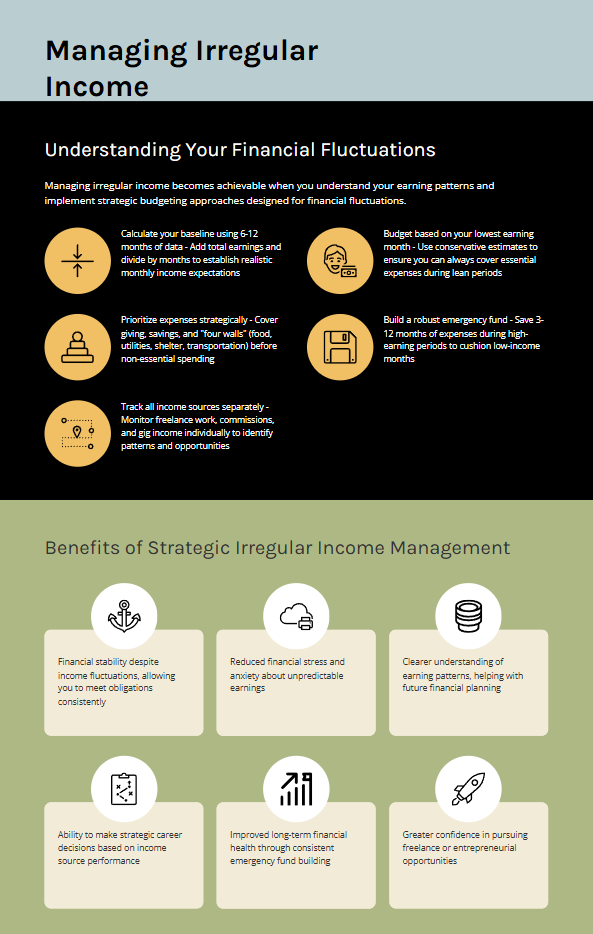
Managing irregular income becomes achievable when you understand your earning patterns and implement strategic budgeting approaches designed for financial fluctuations.
- Calculate your baseline using 6-12 months of data – Add total earnings and divide by months to establish realistic monthly income expectations
- Budget based on your lowest earning month – Use conservative estimates to ensure you can always cover essential expenses during lean periods
- Prioritize expenses strategically – Cover giving, savings, and “four walls” (food, utilities, shelter, transportation) before non-essential spending
- Build a robust emergency fund – Save 3-12 months of expenses during high-earning periods to cushion low-income months
- Track all income sources separately – Monitor freelance work, commissions, and gig income individually to identify patterns and opportunities
When you treat irregular income as manageable rather than chaotic, you transform financial uncertainty into a structured system that provides stability regardless of monthly earning fluctuations.
FAQs
To calculate irregular income, gather your earnings data for the past 6-12 months. Add up the total income for this period and divide by the number of months. For example, if you earned $30,000 over 6 months, your average monthly income would be $5,000.
The most effective budgeting strategy for fluctuating income is to base your budget on your lowest earning month. Prioritize essential expenses like housing, food, and utilities, then allocate remaining funds to savings and non-essentials. This approach ensures you can cover necessities even during leaner months.
For those with irregular income, it’s recommended to save 3-6 months of living expenses in an emergency fund. If you’re self-employed or in a highly variable field, consider aiming for up to 12 months of expenses to provide extra security during low-income periods.
Irregular monthly income refers to earnings that fluctuate from month to month, rather than remaining consistent. This can include income from freelance work, commission-based jobs, seasonal employment, or multiple part-time positions. It creates unique challenges for budgeting and financial planning.
To manage multiple income streams, track each source separately in a spreadsheet or budgeting app. Calculate the average monthly income from each source, then combine them for your total monthly income. Consider using separate bank accounts for different income types to better organize your finances and allocate funds for taxes and expenses.
